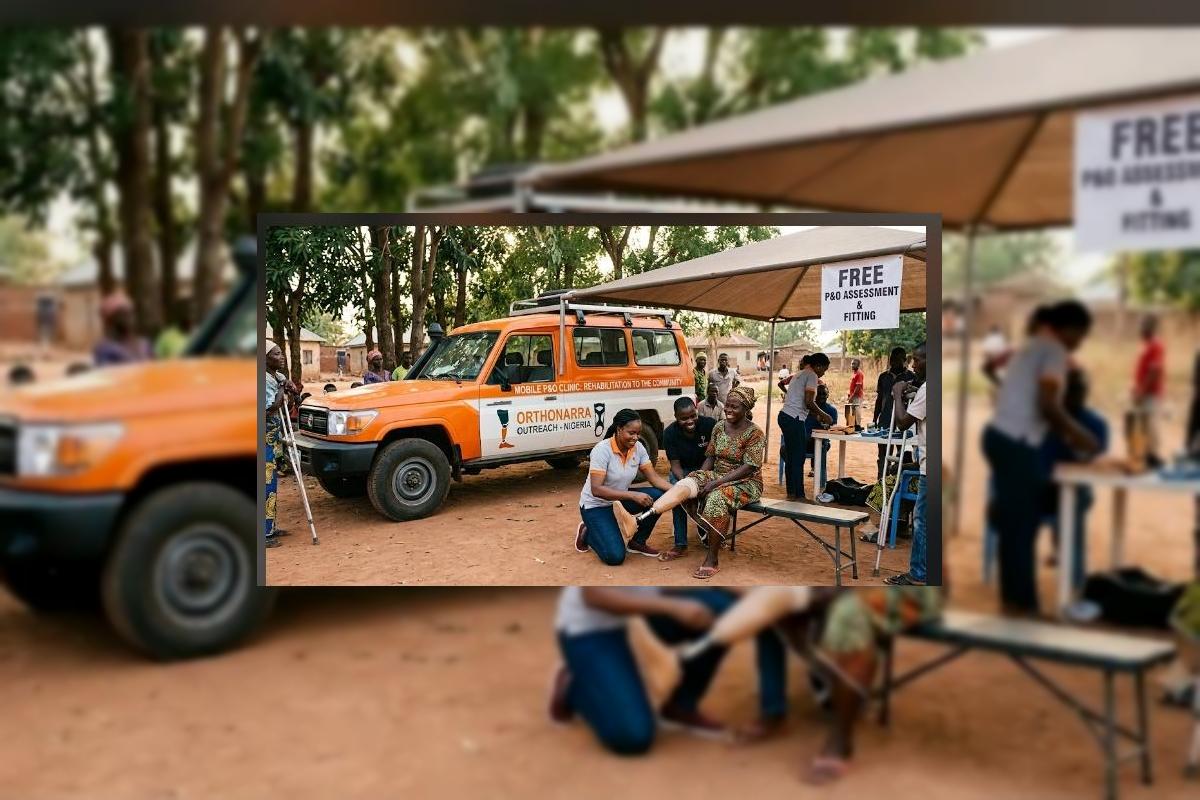

The map of Nigerian healthcare is defined by "distance-to-care." For a patient in a remote village, a shattered bone or a congenital limb difference often means a lifetime of immobility simply because the nearest orthopaedic center is three states away. We have reached the point where we must stop waiting for patients to find the clinic and start bringing the clinic to the people.
"For years, my son’s clubfoot was just something we accepted as his fate. We heard about the big hospitals in the city, but the cost of travel, lodging, and the uncertainty of it all kept us trapped in our village. When the mobile team pulled their van into our community square, I couldn't believe it. They measured him right there, under the mango tree. Two weeks later, his braces arrived. He isn't limping anymore. — Mother of Tunde, Benue State"
In the landscape of prosthetics and orthotics (P&O) in Nigeria, the centralization of services in urban hubs like Lagos, Ibadan, and Kano creates an invisible barrier that excludes millions. Mobile P&O outreach is not just a logistical convenience; it is the most effective tool we have for bridging the equity gap. By deploying mobile workshops—outfitted with scanning technology, thermoplastic heating units, and adjustment tools—we can deliver high-quality rehabilitative care directly to rural communities. This shift turns "rehabilitation" from a distant, expensive dream into a accessible, community-based service.
The Three Logistical Pillars: How We Reach the Unreachable
To successfully run a mobile P&O outreach program, we must master the logistics of remote care. These are the three pillars that keep our operations grounded and effective.
| Pillar | The Tactical Approach | The Goal |
|---|---|---|
| The Mobile Workshop | Standardized vans equipped with power, heating, and diagnostic tools. | Self-sufficient clinical production on-site. |
| Tele-Rehabilitation | Remote follow-ups and gait video analysis for distant patients. | Ensuring continuity of care after the team leaves. |
| Community Hubs | Partnering with local Primary Health Centres (PHCs) for screening. | Building local trust and sustainable referral networks. |
"Mobile outreach is about meeting the patient where their life actually happens. When we remove the friction of travel, the demand for rehabilitative care doesn't just increase—it clarifies the massive, previously hidden need for P&O services across Nigeria."
The Mechanics of Mobile Care: Bringing the Lab to the Field
Effective mobile outreach requires the same standard of care as a city hospital. Our process is built on speed, precision, and durability. First, we partner with local health workers to conduct pre-screening, ensuring the mobile team arrives prepared for the specific needs of that region. Second, we utilize portable casting and modern scanning equipment to capture the anatomy of the residual limb or deformity with millimeter accuracy. Third, our mobile vans are equipped to finish basic orthotics on-site, allowing many patients to walk out with their devices the same day. For more complex prosthetics, we use a "hub-and-spoke" model: the initial measurement happens in the village, the device is fabricated at a central facility, and the final fitting happens when the mobile team returns to the community.
The Five Strategic Advantages of Mobile Outreach
When we take P&O services to the rural grassroots, we generate a multiplier effect that strengthens the entire Nigerian health system:
1 Early Intervention Rates
By appearing in local squares, we catch structural issues in children before they become fixed, irreversible deformities that would require surgery.
2 Reduced Socio-Economic Strain
Families no longer have to sacrifice months of income or travel expenses to seek care, keeping the household economically stable during the treatment period.
3 Local Capacity Building
Our outreach trains local nurses and community health extension workers to recognize P&O needs, embedding expertise directly into rural health systems.
4 Enhanced Patient Adherence
Patients are far more likely to wear and maintain devices when they feel the service was built for their community, not for a city stranger.
5 Data-Driven Resource Allocation
Outreach creates an accurate map of where rehabilitation needs are highest, allowing the government to place permanent facilities exactly where they are needed most.
The Shift: From Institutional Centralization to Community Access
The deep forest green and terracotta palette of this series highlights our commitment to grounded, community-focused solutions. We are breaking the wall between "high-tech medical centers" and the everyday lives of Nigerians in the village.
| The Centralized Model (Exclusion) | The Mobile Model (Inclusion) |
|---|---|
| Care limited to wealthy urban residents. | Care reaching the most vulnerable in rural areas. |
| Patients miss work/school to travel. | Care delivered with minimal disruption to life. |
| High "no-show" rates at city hospitals. | High compliance via community-based engagement. |
| Hidden disability remains invisible. | Active screening and public health visibility. |
Mobile P&O outreach is the bridge that turns the promise of universal health coverage into a reality. It is a bold, necessary acknowledgment that a patient’s geography should never dictate their ability to walk. We have the technology, the training, and the vans—now we need the institutional commitment to make rural outreach a permanent feature of our national rehabilitation strategy. Let us drive the solution to where the problem lives.
A Call for Mobile Integration
To the community leaders: Open your doors and public squares to our mobile teams; your support is the difference between a patient staying home and walking free. To the clinicians: Join our outreach shifts—it is the most impactful way to learn the reality of rural P&O care. To the donors and policymakers: Fund the vehicles and the fuel; every kilometer traveled is a step toward a more mobile, productive Nigeria. OrthoNarra will keep documenting the mobile movement until distance is no longer a disease. Mobility for all, regardless of the map.
Comments (0)
No comments yet. Be the first!
Please login to leave a comment
Login to Comment