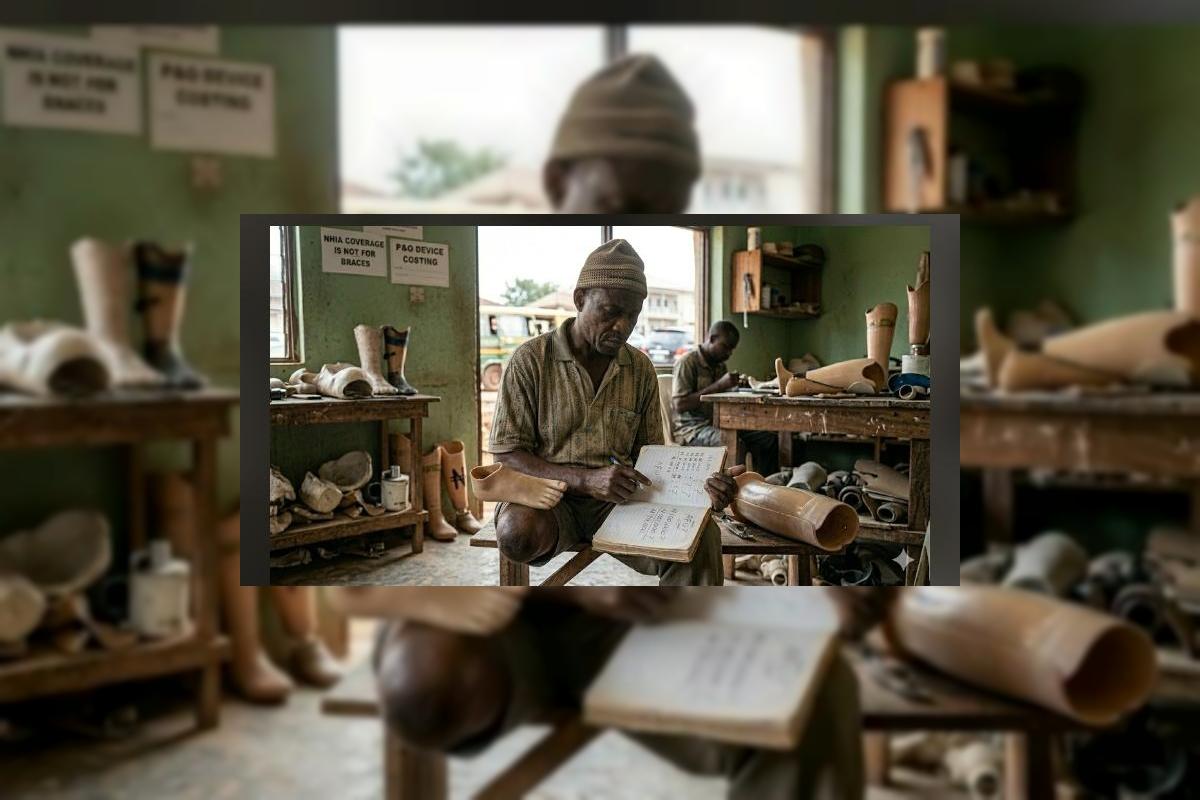

The true crisis of prosthetic and orthotic care in Nigeria does not lie in the scarcity of clinical talent; it is rooted entirely in the cold, unforgiving reality of the healthcare economy. For an amputee waiting for mobility, the exchange rate is a more brutal gatekeeper than any physical barrier.
"When my daughter needed an ankle-foot orthosis (AFO) for her drop foot after an illness in Enugu, the private clinic quoted ₦180,000. My husband’s salary as a state civil servant is barely ₦70,000. The NHIA officer at the hospital told us plain truth: 'The scheme covers the consultation and the paracetamol, but the brace is out-of-pocket.' We had to choose between paying her school fees or watching her limp permanently. In Nigeria, walking is a luxury reserved only for those who can pay upfront. — Mother of Chidinma, Enugu"
In the landscape of healthcare financing in Nigeria, we find ourselves at a devastating impasse where mobility devices are priced as luxury commodities rather than fundamental human rights. Amputees and stroke survivors are routinely forced into lifelong dependency, victims of a framework that classifies prosthetic limb cost as an optional, elective medical expense. Yet, while administrative systems maintain rigid boundaries, the economic burden on families is escalating exponentially. Out-of-pocket payment is not merely an inconvenience; it is a systemic wall. When the state fails to subsidize assistive technology in Nigeria, it effectively sentences lower-income citizens to permanent physical confinement because they cannot survive the upfront financial shock.
The Out-of-Pocket Wall: Three Realities Keeping Amputees Grounded
To properly confront the failures of disability medical expenses management, we must expose the structural gaps within the National Health Insurance Authority (NHIA) and local clinical pricing. These are the economic facts governing every rehabilitation journey in modern Nigeria.
| Economic Barrier | The Financial Impact on Families | The Systemic Intervention |
|---|---|---|
| Import Dollarization | P&O components (valves, carbon feet) track parallel to volatile exchange rates. | Tariff waivers on imported medical-grade prosthetic resins and components. |
| NHIA Exclusion | The national health insurance package explicitly excludes advanced orthotics and prosthetics. | Mandatory inclusion of basic functional mobility devices in the national tariff list. |
| Maintenance Cliff | Sockets require replacement as residual limbs shrink, multiplying lifetime costs. | Establishment of centralized, state-subsidized servicing workshops. |
"An economy that forces an amputated breadwinner to pay ₦600,000 out-of-pocket for a basic below-knee prosthesis is an economy that actively manufactures poverty. We are choosing to fund lifetime dependency rather than funding a single, transformative return to work."
The Dollarization of Walking: The Imported Component Trap
Consider the clinical pipeline at any major center like the National Orthopaedic Hospital, Dala, or a private facility in Lagos. When a clinician prescribes a modular transtibial prosthesis, nearly every raw component—from the mechanical knee joint to the high-grade alignment pylons—is sourced internationally. Because local manufacturing of medical plastics and titanium adaptors is nonexistent, the prosthetic limb cost shifts dramatically with every currency fluctuation. A device that cost ₦350,000 two years ago can easily clear ₦1,200,000 today. This financial strain pushes families toward crowdsourcing, selling ancestral lands, or completely abandoning clinical rehabilitation in favor of cheaper, unscientific roadside alternatives.
The True Math of Mobility: Five Financial Layers of P&O Care
Procuring an affordable, medically sound device involves navigating five progressive expenditure layers that regularly strain the average household budget. This is the financial timeline of out-of-pocket rehabilitation:
1 Surgical Debridement & Pre-Fit Care
Before a device can be cast, families must clear hospital bills for the amputation surgery, wound management, and post-operative compression bandaging.
2 Component Acquisition Costs
The heaviest milestone: paying 100% upfront for the imported foot pieces, alignment adapters, and specialized chemical resins needed to laminate the custom socket.
3 Clinical Fabrication Fees
Compounding the material costs are the institutional bills for the prosthetist’s labor, diagnostic casting, modification processes, and physical alignment sessions.
4 Gait Training & Physiotherapy
A limb cannot function without instruction. Families must fund weeks of specialized physical therapy sessions to teach the patient how to walk safely on the new device.
5 Cyclical Maintenance & Modifications
The financial commitment never completely ends. Sockets must be remade as the residual limb changes shape, and mechanical parts require routine replacements to prevent structural failure.
Macroeconomic Failure vs. Clinical Rehabilitation
Our deep dive into healthcare financing in Nigeria reveals that leaving assistive technology in Nigeria completely to open-market forces is an absolute policy failure. We must bridge the gap between expensive clinical components and the empty pockets of everyday citizens by demanding structural subsidies and local production initiatives.
| The Current Market (Exclusion) | The Covered Future (Inclusion) |
|---|---|
| 100% out-of-pocket payment for basic limbs. | NHIA capitation and co-payment frameworks for P&O. |
| Complete reliance on expensive imported metals. | Investment in local engineering and local materials. |
| Crowdfunding and begging for basic mobility. | Institutional rehabilitation funds at State levels. |
| Abandonment of care; permanent unemployment. | Rapid return to work and active economic contribution. |
The cost of doing nothing is far more expensive than the cost of intervention. Every citizen left sitting at home due to an unaffordable prosthetic limb cost is a productive unit removed from the national GDP. We are keeping families impoverished by forcing them to spend all their liquid capital on basic medical survival. Advocacy for modern healthcare financing in Nigeria must move beyond generic medical coverage talk into specific, targeted reforms for assistive devices. We are not just discussing medical bills; we are discussing the economic freedom of millions of citizens.
A Call to the Nation
To the families: Your desire for a premium rehabilitation journey is valid; do not lose hope while navigating these tough financial terrains. To the philanthropic organizations: Move your funds away from temporary handouts and invest in sustainable institutional P&O endowments. To the policymakers: Subsidizing orthotics and prosthetics via the NHIA is not a charitable donation—it is a strategic macroeconomic investment that returns injured citizens directly to the workforce. The financial wall must come down. Orthonarra will continue to expose these systemic economic gaps until the right to walk is no longer determined by the size of a patient's bank account. Mobility must be affordable for all.
Comments (0)
No comments yet. Be the first!
Please login to leave a comment
Login to Comment